Our recent webinar on UCMR 5 insights, UCMR 6 predictions, and upcoming drinking water regulations for perchlorate was very well attended. I spent several minutes at the end addressing insightful audience questions that are worth sharing here. You can watch the webinar on demand at your convenience and submit any additional questions you may have. I look forward to continuing the conversation!
Watch: Navigating the Next Regulatory Era: UCMR 5 Insights, UCMR 6 Predictions, and Perchlorate Considerations
Q: You mentioned lithium has a Health Reference Level of 10 ppb. If an MCL is established, would it typically match or exceed that?
Health Reference Levels (HRLs) do not come with any EPA guidance, so it is difficult to predict whether a future MCL would match or exceed an HRL. Health Advisory Levels (HALs) do include guidance for actions when levels are exceeded, but EPA has not issued a HAL for lithium yet. In addition, unlike HRLs and HALs, MCLs must also account for financial and technical feasibility. For example, EPA set the HALs for PFOA and PFOS at zero, while the enforceable MCLs for both are 4 ppt.
Q: Do you have any details on regional occurrence indicating a background source for the lithium results?
A: At this time, we have not seen any regional occurrence data that would clearly point to background sources for the lithium results in the UCMR 5 data. Based on our research, lithium can come from several natural, industrial, and household sources:
- Natural Geological Formations: Lithium is naturally found in rocks, soils, and water, particularly in regions with lithium-rich brines and mineral deposits.
- Industrial Activities: Mining operations, especially those extracting lithium for batteries, release wastewater containing lithium into rivers and lakes.
- Pharmaceutical Use: Medications like lithium carbonate and lithium citrate, prescribed for psychiatric conditions, are excreted by patients and enter wastewater.
- Wastewater Effluents: Industrial processes such as ceramics, glass production, and aluminum smelting discharge lithium-containing effluents into municipal water supplies if not adequately treated.
- Personal Care Products: Over-the-counter products may contain lithium compounds and contribute to lithium contamination.
After the webinar, one of our attendees also sent me a link to a 2022 article, showing that lithium levels were higher in the Western states, potentially due to the impact of geological activity on natural lithium deposits.
Q: Has EPA accepted a definition of what constitutes a microplastic?
A: No, EPA has not yet finalized a formal definition for microplastics, but the working definition seems to be solid polymeric particles ranging in size from 5,000 µm to 0.001 µm. The two competing test methods include IR and Raman spectroscopy, with reporting limits of 50 and 20 µm, respectively. This is very much still a developing area, and a definition and standardized test method will need to be determined before microplastics can be added to UCMR 6, let alone be included in future national primary drinking water regulations.
That said, utilities looking for practical guidance today may want to look to California. That state is currently leading in microplastics regulation for drinking water, including test methods and certification of commercial laboratories for multiple particle-size ranges.
Q: What types of microplastics testing can Pace® perform today?
Given the lack of a standardized definition for microplastics and uniform test methods, we have not yet brought microplastics testing for drinking water online. However, we have been closely tracking EPA’s progress on UCMR 6 and the anticipated microplastics requirements. With timelines tightening, we have begun the process of adding microplastics testing, and I expect we will have this capability commercially available within the next several months.
Q: During UCMR 5, do you know what percentage of field reagent blanks (FRBs) showed PFAS contamination?
A: In a large-scale study I completed this past year, I evaluated more than 14,000 FRB data points to understand how often contaminants were detected in FRBs. I intentionally did not include UCMR 5 data because EPA’s mandatory reporting limit for UCMR 5 is about twice our typical, day‑to‑day reporting limit, which would have artificially lowered the apparent hit rate.
When I biased the analysis toward lower reporting limits, the study showed that only 0.79% of FRB results included PFAS detections at or above their reporting limits, indicating a very low occurrence rate of PFAS contamination in FRBs. You can learn more about the study here: PFAS Sampling: Is Cross-Contamination Really an Issue?
Q: How can lithium be remediated via the water treatment process (for example, GAC or PAC)?
A: Several available treatment technologies used today to remove metals can also be effective for lithium. If you are already operating treatment designed for other metals, those same processes may also address lithium, but you should confirm performance through site‑specific testing and monitoring.
Q: Would you consider trifluoroacetic acid (TFA) to be a PFAS compound?
A: Yes, absolutely. In fact, I saw a report that estimated that TFA represents 75% of all PFAS use worldwide. While UCMR 5 focused on longer chain PFAS, it’s possible that UCMR 6 may include some short-chain PFAS. If so, TFA is a likely candidate. We just brought a new method for analyzing ultrashort-chain PFAS online. You can learn more about it here: Ultrashort-Chain PFAS: What They Are and Why They Matter.
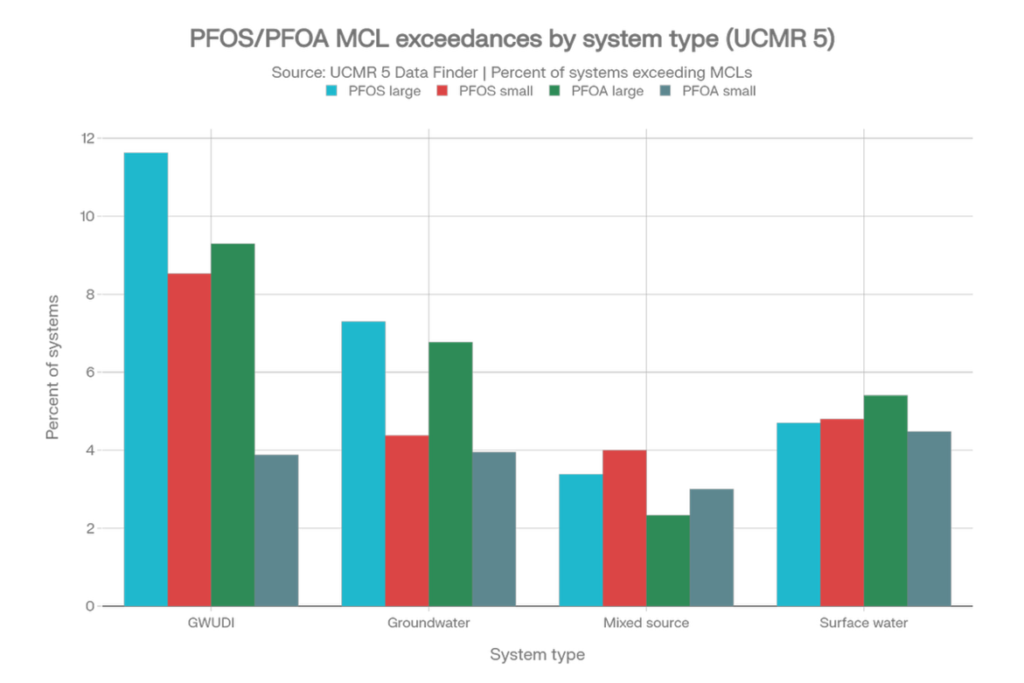
Q: Is there a comparison of PFOA and PFOS results above the MCL during UCMR 5 between groundwater and surface water systems?
I am not aware of a robust, published comparison that specifically looks at PFOA and PFOS exceedances above the MCL in UCMR 5 data, broken out by groundwater versus surface water systems. However, here is a quick comparison based on the data in the latest UCMR 5 Data Finder results: