Pace Logo

Building Sciences

urban apartment complex with playground. 4 Steps to Rental Property Compliance with New York’s Lead Laws

4 Steps to Rental Property Compliance with New York’s Lead Laws

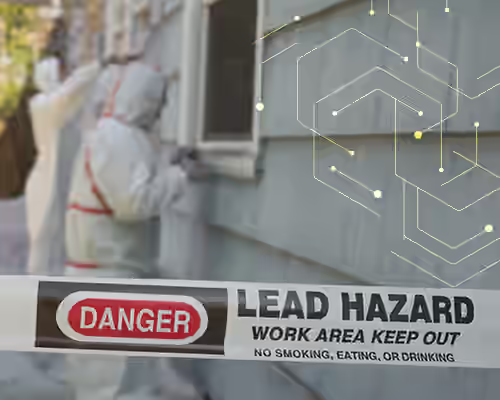
New York State’s lead law for rental properties seeks to reduce lead exposure in homes, especially those with young children. With compliance requirements beginning in 2026, the law focuses on identifying and fixing lead hazards in dust, paint, and bare soil in older housing. As an environmental testing lab, Pace® has years of experience analyzing […]

4 Steps to Rental Property Compliance with New York’s Lead Laws Read More »

Legionella at Sea Blog post Hot tubs on cruise ship.

Legionella at Sea: Cruise Ship Water Management and Testing Programs to Prevent Legionnaires’ Disease

Infection control has become a critical concern for cruise line operators as ships grow larger and amenities become more complex. If not properly managed, confined environments, high passenger turnover, and warm, recirculating water systems create ideal conditions for waterborne pathogens like Legionella to flourish. For brands built on safety and guest experience, a single incidence

Legionella at Sea: Cruise Ship Water Management and Testing Programs to Prevent Legionnaires’ Disease Read More »

6 Common Pitfalls in USP Data Trending—And How to Fix Them

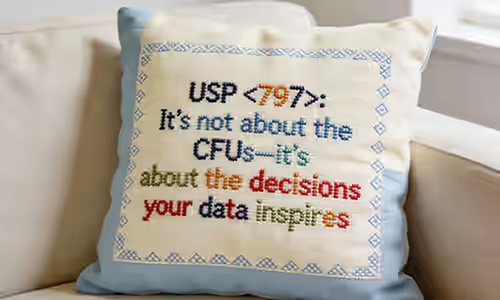
6 Common Pitfalls in USP <797> Data Trending—And How to Fix Them

6 Common Pitfalls in USP <797> Data Trending—And How to Fix Them Has adherence to USP 797 started to feel like a checkbox exercise? Take samples, count CFUs, compare results to USP 797 action levels, file the environmental monitoring report—as long as the CFU counts stay under the limits, it’s all good…right? Or is it?

6 Common Pitfalls in USP <797> Data Trending—And How to Fix Them Read More »

https://blog.pacelabs.com/keeping-pace-with-analytical-services/do-veterinary-practices-need-to-comply-with-usp-standards

Do Veterinary Practices Need to Comply with USP Standards?

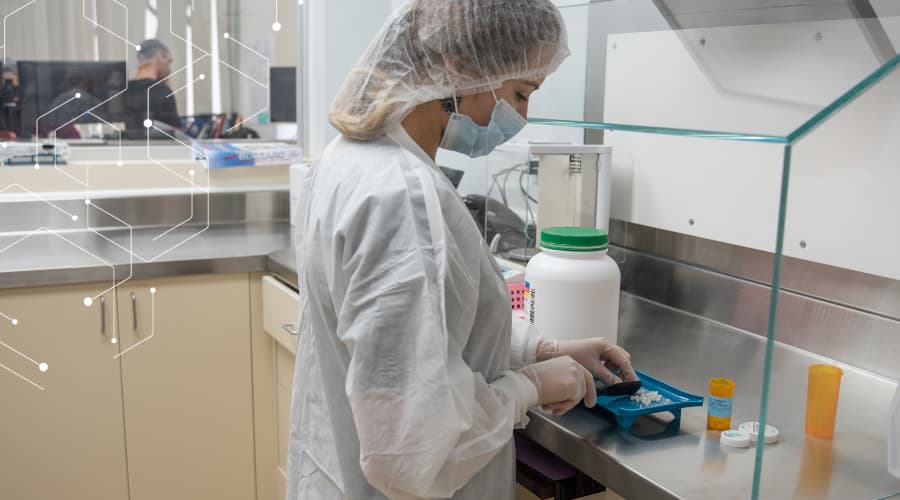
We are commonly asked by veterinary professionals (not to mention concerned friends and family members) whether the United States Pharmacopeia (USP) standards apply to pharmacies and veterinary practices that prepare compounded medications for pets.   The short answer is: Yes! The same USP standards that govern compounding pharmacies serving humans also apply to those providing medications for our beloved non-human family members.  In this blog post, we break down

Do Veterinary Practices Need to Comply with USP Standards? Read More »

Pace acquires QuanTEM Laboartories

Pace® Acquires QuanTEM Laboratories, Expanding Building Sciences & Food Safety Capabilities

Pace® Analytical Services is pleased to announce that QuanTEM Laboratories, LLC, a respected environmental sciences and food microbiology testing laboratory based in Oklahoma City, has officially joined the Pace® network. This acquisition strengthens our national footprint and expands our capabilities in several key service areas, including asbestos analysis, environmental lead testing, microbiology, and food safety testing.  This

Pace® Acquires QuanTEM Laboratories, Expanding Building Sciences & Food Safety Capabilities Read More »

Using Fecal Source Tracking to Detect and Identify Fecal Contamination and Protect Public Health

Using Fecal Source Tracking to Detect and Identify Fecal Contamination and Protect Public Health

Clean water is fundamental to healthy communities, thriving ecosystems, and safe recreation. One of the greatest threats to water quality is contamination from fecal matter, which can carry harmful bacteria, viruses, and parasites. In this post, we provide an introduction to Fecal Source Tracking: what it is, how it’s done, and how it can be used

Using Fecal Source Tracking to Detect and Identify Fecal Contamination and Protect Public Health Read More »

What Compounding Pharmacies Nationwide Can Learn from California

As a standard of minimums, USP <797> lays a solid foundation for preserving patient safety and the efficacy of compounded sterile preparations. The expectation is that pharmacies will conduct further risk assessments to establish more detailed SOPs that address specific areas of their business. Not content to leave it up to their members, some state

What Compounding Pharmacies Nationwide Can Learn from California Read More »

Expanding Capabilities Through Collaboration: Inside the Integration of DCM Science Laboratory and Pace® Analytical

Expanding Capabilities Through Collaboration: Inside the Integration of DCM Science Laboratory and Pace® Analytical

I recently sat down with Rob DeMalo, Vice President of Operations for Building Sciences, and Ron Schott, former owner of DCM Science Laboratory and an expert in x-ray diffraction, mineralogy, and microscopy. We talked about how the integration of DCM Science Laboratory with Pace® Analytical brings together complementary strengths, expanding capabilities and creating new opportunities to

Expanding Capabilities Through Collaboration: Inside the Integration of DCM Science Laboratory and Pace® Analytical Read More »

Is Your Healthcare Facility Joint Commission Survey Ready?

Is Your Healthcare Facility Joint Commission Survey Ready?

While Joint Commission accreditation lends credibility to a healthcare organization and helps them earn public trust, it also comes with a caveat: regular visits or “surveys” from Joint Commission officials. Since the Joint Commission has no duty to inform the facility of a visit ahead of time, healthcare facilities looking to maintain their accreditation must

Is Your Healthcare Facility Joint Commission Survey Ready? Read More »