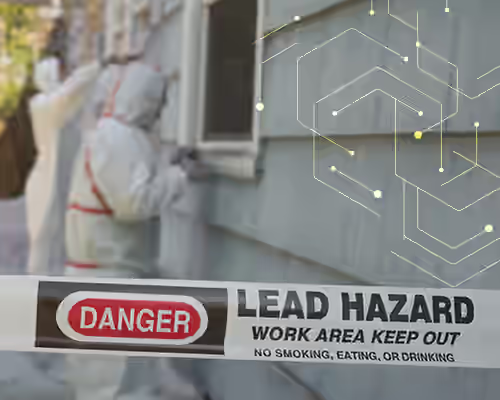
Across the country, states are revising their lead standards to align with new federal rules that took effect in January 2025, with most regulated parties required to meet the stricter limits by January 12, 2026. In a recent post, we looked at the lead rules taking effect in New York in 2026. In this post, we step back to examine the federal laws driving the renewed focus on lead in homes, especially where young children live.
Federal Lead Laws: What Changes in 2026?
Under 40 CFR 745.65, EPA’s “leadbased paint hazards” rule, a lead hazard can come from deteriorated lead-based paint, contaminated house dust, or lead-contaminated soil in and around housing and child-occupied facilities. Effective January 13, 2025, the rules redefined what counts as a lead hazard in homes and child-occupied buildings and tightened the standards used after abatement and other work that may disturb lead-based paint.
The revised rule introduced the Dust-Lead Reportable Level (DLRL), which is any level of lead in dust that an EPA-recognized laboratory can reliably detect and report. For regulatory purposes, any dust-lead result at or above the DLRL is now treated as evidence of a dust-lead hazard in homes and child-occupied buildings.
The rule also renamed the post-abatement clearance standards from clearance levels to Dust-Lead Action Levels (DLAL). DLALs are very low dust-lead concentrations—currently ≤5 µg/ft² on floors, ≤40 µg/ft² on interior windowsills, and ≤100 µg/ft² on window troughs. EPA determined these to be the lowest levels laboratories can reliably and quickly measure after cleanup.
In short, these changes mean that any reportable dust-lead finding must be treated as a hazard (DLRL), while DLALs set the benchmark for how clean a home must be after abatement to pass clearance. Property owners and managers were given a one-year grace period (until January 12, 2026) to comply with these new rules.
Changes in Lead Laboratory Requirements
Most federal lead programs—including EPA’s rules and HUD’s Lead Safe Housing Rule—require you to use a laboratory that is recognized under EPA’s National Lead Laboratory Accreditation Program (NLLAP). States and tribes that run their own authorized lead programs generally accept NLLAP-recognized labs as the baseline but can layer on extra requirements, so it is still important to confirm with the specific state or funding program before you sample.
That said, the new lead law requirements, especially the DLRLs, may require property managers and landlords to reassess their lab partner’s capabilities. Many laboratories perform analyses using Flame Atomic Absorption (FAA), which often cannot achieve the lower detection and reporting limits (DLRL) required by the revised federal lead laws. In addition to FAA, Pace® can utilize advanced Inductively Coupled Plasma (ICP) instrumentation, allowing for enhanced sensitivity and precision to meet these stringent requirements.
Contact Pace® to find an NLLAP-accredited laboratory
Who Is Impacted by the New Federal Lead Dust Laws?
Children are especially vulnerable to lead dust because their growing brains and nervous systems are more easily harmed, and their frequent hand-to-mouth behavior means they swallow more dust than adults, particularly when relative body size is considered. The federal dust-lead laws were created to reduce lead exposure in homes and in child-occupied places like daycares and preschools where lead-based paint may still be present. The federal rules also apply to single-family homes built before 1978 or to certain “targeted” housing, such as HUD-assisted units or properties covered by specific financing or regulatory programs.
Which Agency is Responsible for Enforcing Federal Lead Laws?
Under the Toxic Substances Control Act (TSCA), EPA’s dust-lead hazard and clearance standards in 40 CFR 745.65 are federal definitions that apply nationwide on the federal effective (January 13, 2025) and compliance (January 12, 2026) dates.
Several states have been authorized by EPA to administer their own lead dust/abatement programs. These states are given until January 12, 2027—two years from the effective date of the federal laws—to update their program. State laws must be at least as restrictive as federal law. If they fail to meet the requirement or timeline, EPA can move to withdraw their authorization.
During that gap, the state may still be enforcing its older numbers on paper, but EPA (and, for assisted housing, HUD) can enforce the stricter federal hazard definitions and action levels.
For a property owner, the practical consequence is that focusing on state laws only is risky if state limits are looser than the current 40 CFR 745.65 standards. The compliance-safe approach is to follow the stricter federal standards, even in states that have not yet updated their regulations.
Key Dates and Compliance Timeline
The timeline below shows when the rule was issued, when its core provisions took effect, and when states and tribes must fully align their own programs with the federal standards.
- November 12, 2024 – EPA published the final rule “Reconsideration of the Dust‑Lead Hazard Standards and Dust‑Lead Post‑Abatement Clearance Levels.”
- January 13, 2025 – Rule became effective; revised DLRL and DLAL standards and terminology began to apply, but with a delayed compliance deadline for some elements.
- January 12, 2026 – Full federal compliance requirements went into effect.
- January 11, 2027 – Deadline for EPA-authorized‑ state and tribal programs to update their standards to be at least as protective as the federal rule.
Additional Federal Dust-Lead FAQs
Here are answers to a few additional questions about how the new federal dust-lead standards apply in real-world situations for property owners, managers, and lead professionals. Be sure to check with your local authorities to ensure compliance with all local requirements for your property.
Q: How do these changes impact HUD grant funding?
The new EPA dust-lead standards raise the bar for what counts as a lead hazard, which in turn raises expectations for HUD-funded work. HUD’s Lead Safe Housing Rule already requires that assisted properties have “no dust-lead hazards” as defined by EPA. This means HUD-assisted housing and HUD-funded hazard control projects must effectively treat any reportable dust-lead as a condition that needs attention.
While the new standards can increase the scope and cost of abatement, interim controls, and clearance testing on HUD grants, the way HUD will align every grant stream with the new EPA values is not yet fully transparent, and some program guidance still lags behind the federal rule language. Managers of HUD-funded projects should verify with their grant or program contact which dust-lead values are legally required for that work and how those values should be applied in risk assessments, work writeups, and clearance.
Q: Did any rules change for lead in soil?
Paint and soil hazard definitions remain in place but become more consequential because any associated dust they generate will almost always be treated as a hazard once detected. Under 40 CFR 745.65, a soil-lead hazard is bare soil on residential property or at a child‑-occupied‑ facility with total lead at or above 400 parts per million in a play area, or an average of 1,200 parts per million in the rest of the yard.
Q: How often does a covered property need to be tested for lead?
Testing frequency is not defined by 40 CFR 745.65. Rather, it is determined by other federal programs (such as HUD’s Lead Safe Housing Rule or specific financing/assistance requirements), state or local regulations, or by the terms of a particular loan, grant, or regulatory agreement.
Q: Do I have to go back and retest properties that already passed clearance?
While the federal dust-lead rule itself does not require retesting properties that have already passed clearance, some state, tribal, or local codes—and certain HUD housing programs—do require periodic reevaluations or follow-up inspections after hazard control work. Rental licensing ordinances and health or housing codes in some jurisdictions also authorize inspectors to order new testing if they identify deteriorated paint, visible dust, or other conditions suggesting that lead hazards may have reappeared, so it is important to check the rules and guidance for your specific state and locality.
Q: Do these rules change my RRP work?
The revised dust-lead standards do not change the federal Renovation, Repair and Painting (RRP) Rule: You must still be lead-safe certified, follow the same containment and cleaning practices, and provide required notices. The new DLRL/DLAL values matter only if your renovation is tied to a risk assessment, abatement project, or HUD-assisted housing requirement that mandates clearance, in which case the lower action levels will control whether the job “passes.”
Q: What do I have to disclose to tenants or buyers under the federal lead disclosure rule now that ‘any reportable level’ is a hazard?
The federal Lead-Based Paint Disclosure Rule still requires you to disclose any known lead-based paint or lead-based paint hazards, provide all available reports, and give buyers or tenants the EPA pamphlet “Protect Your Family from Lead in Your Home” before they sign a contract or lease. Under the new standards, if you have test results showing reportable dust-lead on floors or sills—or identified paint or soil hazards—those results now count as “known hazards” and should be shared as part of your disclosure packet, rather than being dismissed as “below the old standard.”
How Can We Help?
If you have questions about how to collect representative samples or how the new federal standards affect your projects, Pace® can help. Our team works with property owners, housing programs, and consultants nationwide on dust wipe, paint chip, and soil-sampling strategies that meet EPA, HUD, and state requirements. We also provide accredited lead analysis, advanced instrumentation and clear result reporting aligned with the new “reportable” and “action” levels, and technical support to help you interpret findings and plan next steps. Contact Pace® to discuss your property, project scope, or compliance questions or to request a quote.