A Q&A with Johnny Mitchell, CTO of Pace® Analytical
When the U.S. Environmental Protection Agency finalized new restrictions on methylene chloride in 2024, environmental laboratories across the country immediately understood the implications. The solvent, long essential to traditional semi-volatile organic compound (SVOC) testing under EPA Method 8270, suddenly came with dramatically tighter exposure limits and growing concerns about long-term supply and operational sustainability.
For Pace®, the new rule was more than a compliance challenge. It became the catalyst for rethinking how environmental testing could be performed more safely, efficiently, and sustainably.
At the center of that effort is Johnny Mitchell, CTO of Pace® Analytical, who has helped lead the development of a next-generation approach that combines triple quadrupole GC/MS/MS technology with reduced-volume extraction methods.
We sat down with Johnny to discuss what the new methylene chloride requirements mean for the industry and how Pace® is preparing customers for the future of EPA 8270 testing.
Let’s start with the regulation itself. Why has methylene chloride become such a major issue for environmental laboratories?
Johnny: The industry is facing a very real operational shift. EPA finalized stricter exposure limits for methylene chloride because of potentially significant health concerns.
Environmental laboratories can still use the solvent, but the allowable exposure levels dropped dramatically from 25 ppm down to 2 ppm, with an action level at 1 ppm.
That changes the entire conversation around traditional extraction methods. Labs that historically used hundreds of milliliters of methylene chloride per extraction now have to think differently about safety, sustainability, ventilation requirements, solvent handling, and long-term supply availability.
How did Pace® respond to that challenge?
Johnny: Instead of trying to preserve the old workflow, we asked a different question: What would EPA 8270 look like if we designed it today using modern instrumentation?
That led us to combine triple quadrupole GC/MS/MS technology with a reduced-volume extraction process using only 40 mL sample vials.
The result is a dramatically more efficient workflow that reduces methylene chloride consumption by approximately 99% while maintaining, and in many cases improving, analytical performance.
What makes triple quadrupole technology so important to this evolution?
Johnny: Triple quadrupole instrumentation gives us significantly greater sensitivity and selectivity than traditional systems.
Historically, environmental labs relied on larger sample volumes partly because they needed enough extracted material to achieve the required detection capability. With GC-MS/MS, we can confidently work with much smaller sample volumes while still producing high-quality, defensible data.
That’s really the breakthrough here. The technology allows us to modernize the entire workflow .
What does that modernization actually look like for customers?
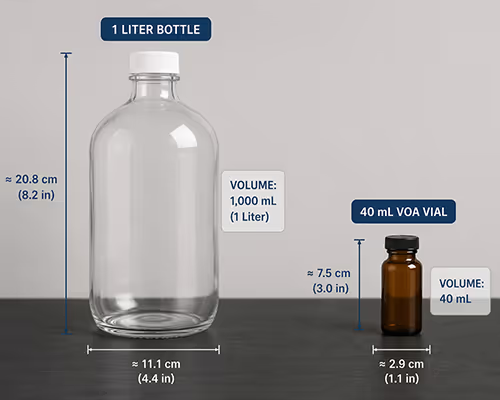
Johnny: The differences are substantial. Traditional workflows often required large sample containers, multiple extraction steps, lengthy processing times, and significant solvent use. In many cases, labs were working with 100 mL to 1-liter sample containers and using hundreds of milliliters of methylene chloride.
With the new workflow, we’re now using compact 40 mL vials and only about 4 mL of solvent. Extraction time drops from six or seven hours down to roughly two and a half hours.
For customers, that means:
- Faster laboratory processing
- Easier field sampling
- Reduced shipping weight and cooler space
- Lower risk of bottle breakage
- Less chance of needing costly re-sampling events
It simplifies the entire process from field collection to final reporting.
Q: Beyond operational improvements, how does this support sustainability goals for laboratories and customers?
Johnny: Sustainability is a major part of this story, even though the initial driver was regulatory change. As new EPA regulations reshape the use of methylene chloride, environmental laboratories remain exempt from the ban but must now comply with far stricter exposure limits. That reality is accelerating the need for safer, lower-volume laboratory processes across the industry.
At Pace®, we’ve reimagined how EPA 8270 testing can be performed more sustainably by combining advanced Reduced Volume Technology with next-generation triple quadrupole GC/MS/MS instrumentation. This innovative approach dramatically reduces methylene chloride consumption while maintaining the precision, reliability, and data quality customers depend on.
The impact goes well beyond the laboratory itself. Reduced solvent use supports safer working environments, lowers hazardous chemical waste generation, reduces shipping and material demands, and helps customers better manage long-term testing costs in a changing regulatory environment.
Ultimately, this is about advancing a smarter, safer, and more sustainable future for environmental testing without compromising analytical performance.
Q: You’ve described this as more than just a new method — more like a long-term platform. What do you mean by that?
Johnny: The long-term vision is workflow consolidation. Historically, environmental testing often required separate extractions and separate analyses for different compound groups. What we’re building toward is the ability to analyze semi-volatiles, pesticides, and eventually additional analyte groups from a single extraction and potentially a single injection. That’s a major shift for the industry.
Q: Final question — what excites you most about this transformation?
Johnny: What excites me is that this isn’t just about regulatory compliance. It’s about building a smarter environmental testing model.
We’re making sampling easier in the field, improving safety in the laboratory, reducing chemical dependency, increasing efficiency, and preparing for future regulatory realities, all while maintaining the high-quality data our customers depend on.
That’s the bigger story here.