EPA proposed the sixth Unregulated Contaminant Monitoring Rule (UCMR 6) on July 1, 2026. As proposed, the rule requires monitoring for 30 unregulated chemical contaminants during a 12-month monitoring period between January 2028 and December 2030.
That may sound comfortably distant, but water professionals involved in past UCMR cycles know that 2027 will be a critical year for ensuring monitoring plans and budgets align with program requirements.
Watch: US EPA UCMR 6 – What’s Next
In this post, we’ll touch on some of the most critical details and answer some questions we’re already fielding from clients. With that in mind, let’s start with the most obvious one:
Q: What’s changed from UCMR 5 to UCMR 6?
The UCMR 6 proposal generally follows the UCMR 5 framework in every aspect except for the 30 contaminants chosen.
First, the proposed monitoring population follows the established size-based structure:
- All community water systems and non-transient non-community water systems serving more than 10,000 people would participate.
- All applicable systems serving 3,300 to 10,000 people and 800 smaller systems randomly selected by EPA would participate, subject to available EPA appropriations and sufficient laboratory capacity.
The monitoring location and sampling schedule also remain familiar. Systems would collect samples at the entry point to the distribution system during the EPA-assigned monitoring period. As in previous UCMR cycles, the proposed rule uses source-water categories to determine whether a system completes two or four sampling events: all systems would have SE1 and SE2 events, while surface-water systems, groundwater systems under the direct influence of surface water, and mixed-source systems would also complete SE3 and SE4.
Finally, the respective responsibilities of large and small systems also generally follow the UCMR model:
- Systems serving more than 10,000 people would be responsible for their analytical costs and would need to contract with an EPA-approved UCMR 6 laboratory.
- Subject to availability of funds, EPA plans to help pay for the analysis of samples from participating systems serving 10,000 or fewer people.
- Laboratories will submit data to EPA’s Safe Drinking Water Accession and Review System (SDWARS 6).
In other words, the administrative side of UCMR 6 is likely to feel familiar, allowing water systems to concentrate their planning efforts on the analytical requirements. That is especially important because the proposed contaminant list represents a significant change and includes testing for analytes that may be unfamiliar to some.
Q: Which contaminants are included in the UCMR 6 proposal?
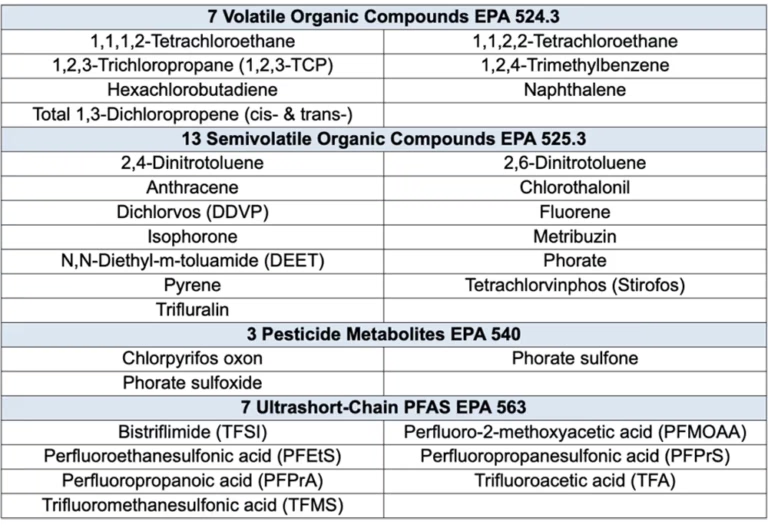
The proposed UCMR 6 contaminant list contains 30 chemicals across four analytical-method groupings:
Q: I’ve heard conflicting information on how many PFAS are included in UCMR 6. Can you clarify?
The confusion comes down to definitions. UCMR 6 proposes to monitor seven ultrashort-chain organofluorine compounds using EPA Method 563, but EPA does not classify all seven as PFAS under the structural definition it used for Contaminant Candidate List 5 (CCL 5).
Under that definition, only four of the seven are PFAS:
- Perfluoropropanesulfonic acid (PFPrS)
- Perfluoropropanoic acid (PFPrA)
- Perfluoroethanesulfonic acid (PFEtS)
- Perfluoro-2-methoxyacetic acid (PFMOAA)
The other three—trifluoroacetic acid (TFA), trifluoromethanesulfonic acid (TFMS), and bistriflimide (TFSI)—are included in the proposed monitoring list as ultrashort-chain organofluorine compounds but do not meet EPA’s CCL 5 PFAS definition. That is why EPA describes the group as “ultrashort organofluorine compounds, including certain PFAS,” rather than simply calling all seven PFAS.
When you see outside sources (including us) refer to all seven as ultrashort-chain PFAS, that reflects the fact that PFAS definitions vary among regulators, scientific organizations, and stakeholders. EPA’s CCL 5 definition requires one of three specified carbon–fluorine structures, including a qualifying CF2 or CF2OCF2 arrangement.
In the webinar, we covered testing for these compounds and some of the analytical nuances you may want to be prepared for. The bottom line is that you cannot assume that a laboratory’s existing PFAS experience automatically means it is prepared to support every proposed UCMR 6 method at the required reporting levels.
Q: Will EPA issue blanket laboratory approvals for UCMR 6 or will laboratories need to be approved for each test?
EPA approves individual laboratory locations for specific UCMR analytical methods. For example, under the proposed UCMR 6 framework, a laboratory could potentially be approved for EPA Method 563 for ultrashort-chain organofluorine compounds, but not for EPA Method 540, 525.3, or 524.3. EPA approval is also tied to the specific physical laboratory location, not to every location operated by the same company.
Q: Can we use multiple laboratories for UCMR 6?
Yes—provided the final UCMR 6 rule retains the same structure as the proposal and prior UCMR cycles, a water system may use more than one laboratory. For example, a system might use one EPA-approved laboratory for Method 563 ultrashort-chain organofluorine compounds and another approved laboratory for the remaining UCMR 6 methods.
However, multi-lab arrangements can add considerable administrative overhead. The water system must ensure each laboratory can support the assigned monitoring schedule, provide the correct sampling materials and instructions, meet UCMR quality-control requirements, and submit data properly through EPA’s reporting system.
Why 2027 matters
Although sample collection is proposed to begin in 2028, water systems should treat 2027 as the year to resolve a few practical questions.
For large systems in particular, EPA’s proposed schedule anticipates that systems collecting samples in the first year of monitoring will make laboratory arrangements in 2027. However, under EPA’s proposed program timeline, laboratories seeking UCMR 6 approval don’t need to complete registration and application materials until August 1, 2027.
Not knowing how quickly EPA will be able to approve applications if there is a backlog, water systems may not want to wait for EPA approval before they choose a UCMR 6 laboratory partner. To stay ahead of 2028 sampling schedules, they can use 2027 to assess:
- Whether their existing laboratory relationship can perform all four proposed UCMR 6 methods.
- Whether the laboratory intends to obtain EPA approval for each specific UCMR 6 method it will perform.
- Whether the laboratory has the capacity, logistics, sample kits, preservation requirements, reporting workflows, and quality-control procedures to support the system’s scheduled monitoring.
- Whether sampling personnel understand method-specific collection and handling requirements, particularly for ultrashort-chain organofluorine compounds.
- Whether internal teams are prepared for SDWARS 6 account setup, schedule review, sample-point verification, results review, and public communication requirements.
Laboratory selection is more than a procurement decision; it is a core part of UCMR 6 readiness, and the earlier your system starts that conversation, the more ready you will be. Pace® has supported water systems through every UCMR cycle since the program’s inception. If you’re weighing whether your current laboratory relationship is ready for UCMR 6 or want a second opinion before committing your 2027 budget, our team is a good place to start that conversation.
Contact Pace®
Watch Our UCMR 6 Webinar On-Demand
UCMR 6 is still in the proposal stage, but EPA intends to finalize it by the end of this year. For a closer look at the proposed rule, its contaminants and analytical methods, laboratory considerations, and sampling challenges, be sure to watch our recent webinar, now available on demand.
Watch: US EPA UCMR 6 – What’s Next