
New Jersey Legionella Law Update
- By: Dr. Michael Berg
- Tags: Legionella
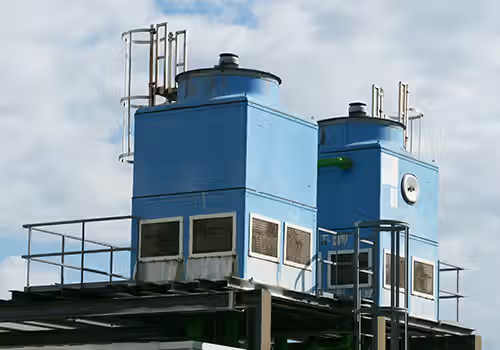
What Cooling Tower Owners Need to Do Before December 12
In 2024, New Jersey enacted P.L.2024, c.66 (S2188/A1970), widely regarded as one of the most comprehensive Legionella laws in the country. In earlier posts, we covered what the law means for Public Community Water Systems and facilities managers. In August, we also flagged the law’s two compliance deadlines.
The first deadline has now passed. Since September 12, 2026, covered buildings and facilities have been required to have a written Legionella water management program in place. The second deadline is right around the corner. By December 12, 2026, water management programs for covered facilities must be fully implemented, not just recorded on paper.
Cooling Towers in the Spotlight
New Jersey’s law covers a wide range of buildings, from hospitals and nursing homes to hotels and high-rises. Many of these facilities may already have water management programs because they were required by existing laws; e.g., federal CMS rules require water management plans for healthcare facilities. Water management planning and Legionella control are also brand management issues for many businesses, such as hotels, resorts, and cruise ships.
But New Jersey’s law also applies to any building with a cooling tower or evaporative condenser, regardless of the facility’s primary purpose. That includes many office buildings, data centers, schools, manufacturing plants, and other types of facilities that have never had to meet a Legionella control mandate.
New Jersey didn’t adopt these requirements in a vacuum. Legionnaires’ disease is a persistent public health problem in the state. According to the New Jersey Department of Health (NJDOH), 309 cases were reported in 2025, about 3.3 cases per 100,000 residents. Because the disease is often misdiagnosed as other types of pneumonia, the true number is likely higher. And the consequences can be serious: the CDC reports that about one in 10 people who develop Legionnaires’ disease die from it.
What the New Jersey Legionella Law Requires for Buildings with Cooling Towers
As we noted in our earlier post, Section 6 (C.26:1A-140) casts the widest net in New Jersey’s law. It covers any building with a whirlpool, spa, pool, open-circuit or closed-circuit cooling tower, or evaporative condenser that cools an HVAC or refrigeration system, along with other devices that release water aerosols.
There is some good news for owners whose only covered system is a cooling tower. The law requires a water management program for the only listed device, not the entire building, unless the facility is covered for another reason. For example, a hospital, long-term care facility, hotel, high-rise, or other covered facility with a cooling tower still needs a building-wide program, but an office building with a cooling tower may not.
The Legionella water management program for cooling towers must be consistent with ASHRAE Standard 188, Legionellosis: Risk Management for Building Water Systems, or a comparable national standard. For a cooling tower, that typically means:
- Describing the system and how water flows through it
- Identifying where Legionella could grow and spread
- Setting control measures and limits, such as biocide residual, pH, and conductivity
- Defining how those limits will be monitored and how often
- Spelling out corrective actions when results fall outside the limits
- Documenting everything
From Paper to Practice: What “Implemented” Looks Like
A written plan sitting in a binder won’t satisfy the December deadline. Implementation means the program is running and you can prove it. Before December 12, cooling tower owners should be able to check off the following:
- The written water management program is complete and covers every cooling tower and evaporative condenser on the property.
- Control limits (biocide residual, pH, conductivity, temperature) are set and monitored on a defined schedule.
- A Legionella testing schedule is in place, with samples analyzed for Legionella pneumophila at minimum. Collect baseline samples now so you have results in hand before the deadline.
- Corrective actions are written out for out-of-range readings and positive Legionella results, following ASHRAE 188 and CDC guidance.
- A procedure exists for reporting positive results to NJDOH.
- Staff and water treatment vendors know their roles and have been trained on the program.
- Annual offline cleaning and disinfection is scheduled, along with startup and shutdown procedures for seasonal towers.
- Logs, service reports, and lab results are filed on site, ready to hand over immediately on request.
- A written public notice that the program has been implemented is posted on the premises where occupants can easily see it.
It’s important to note that New Jersey does not currently require cooling tower owners to register their systems with the state, although registration bills have been introduced in the legislature. In the meantime, routine Legionella testing provides documented proof that a water management program is working—valuable whether registration becomes law or not.
Frequently Asked Questions About New Jersey’s Legionella Law and Cooling Towers
New Jersey’s Legionella law raises several practical questions for cooling tower owners and facility managers, from what the law requires today to how often towers should be tested. Below are answers to the questions we hear most often, along with what to watch for as the state considers additional requirements.
My cooling tower is shutting down for the season. How do I address that in my water management plan?
Seasonal shutdowns and restarts are some of the highest-risk periods for a cooling tower, so your water management program should address both.
During a short shutdown—A tower that isn’t drained is still a Legionella risk. NJDOH’s Dear Cooling Tower Operator letter recommends maintaining the water treatment program during wet standby, which it defines as a system that hasn’t been drained and has been shut down for less than five days. It also recommends circulating water through the system three times a week.
At shutdown and startup—NJDOH recommends following the manufacturer’s recommendations for cleaning and disinfection after shutdown, when idling, and before startup. Stagnant water that sits over the winter can let biofilm and Legionella build up, so a spring restart without cleaning can release that growth into the air.
After restart—Consider sampling for Legionella soon after startup to confirm the system is under control before the cooling season is in full swing. Your program should define a sample schedule and what to do if results come back positive.
Is Legionella testing mandatory for cooling towers?
It depends on the building. The law requires periodic sampling and testing for hospitals, licensed long-term care facilities, buildings linked to a Legionnaires’ disease outbreak, and any building or facility for which the CDC recommends periodic sampling. If one of these buildings has a cooling tower, testing must be part of its water management program.
For buildings covered only because of a cooling tower, the law allows testing but doesn’t require it. NJDOH’s Dear Cooling Tower Operator letter (updated March 2025) still makes its expectations clear: it recommends testing cooling towers for Legionella at least every three months while they are operating. The letter also calls for offline cleaning and disinfection at least once a year.
Bear in mind that testing can also be ordered. During a Legionnaires’ disease investigation, NJDOH or the local health officer can require the owner of a suspected source to test, remediate, report results and notify the public.
If testing isn’t required, why should I test for Legionella anyway?
A water management program is only as good as the evidence that it works. Monitoring biocide levels, pH and conductivity tells you whether your control measures are in place. Only Legionella testing tells you whether they’re actually keeping the bacteria in check. Routine results provide documented proof that your program is effective and can help you spot problems and correct them before they become a public health concern.
Testing also protects your organization’s reputation. Cooling tower droplets can travel well beyond the property line, so a tower can be linked to illness in the surrounding community, not just among building occupants. If a Legionnaires’ disease case is ever traced to your area, a record of routine testing and timely corrective action shows that you took the risk seriously. Without that record, it’s much harder to defend your program to regulators, tenants, customers, or the public.
What do we need to test for?
Under the law, all sampling and testing must include Legionella pneumophila, the species responsible for most cases of Legionnaires’ disease. Testing must also follow NJDOH rules and best practices, along with ASHRAE 188.
Owners must use ASHRAE 188 and CDC guidelines to interpret and respond to positive results. Positive results must also be reported following NJDOH procedures. Your water management program should outline ahead of time what you’ll do at each result level so fewer decisions are made under pressure.
Do we need to tell our lab to use a specific test method?
The law doesn’t name a specific method, but your choice matters. Culture remains the method of record for most compliance reporting. Pace® performs culture testing at laboratory locations that participate in the CDC’s ELITE proficiency testing program.
Turnaround is the trade-off. Conventional culture can take 7 to 10 days, and cooling tower samples are especially hard to read because background bacteria can overgrow a plate before Legionella colonies are large enough to count. That’s where MICA testing can help. MICA is a culture-based method that counts live, culturable L. pneumophila, with results in about three business days. Because it identifies microcolonies at 48 hours, before most competing bacteria take over, it’s well suited to cooling tower water.
MICA is an AOAC Performance Tested Method, but it isn’t currently part of the CDC ELITE program or state accreditation programs. That’s why Pace® recommends using MICA alongside standard culture: culture for your compliance record, and MICA for a faster read on whether your program is working. In most cases, a single 100 mL non-potable sample provides enough volume for both.
I’ve heard I can test with Legiolert myself. Will that suffice?
Legiolert is a culture-based test for Legionella pneumophila, the species the New Jersey law requires. Before settling on Legiolert as your preferred method, here are a few factors to consider:
- Independence. If the same team that manages your cooling tower also tests it, your results may carry less weight with regulators, insurers, and the public. Results from an independent laboratory provide stronger evidence that your program is working.
- Quality control. Laboratory testing involves trained analysts, documented procedures, proficiency testing, and chain of custody. In-house testing may not, and that can make results harder to defend if they’re ever questioned.
- Limits of the method. Legiolert reports results as a most probable number (MPN) rather than colony-forming units (CFU), and it doesn’t produce isolates. If a Legionnaires’ disease case is ever linked to your building, investigators may need isolates for serogroup identification and comparison with clinical samples, and conventional culture is required for that.
- High number of false positives. Legiolert can produce false positives, particularly in non-potable water like cooling towers, where other bacteria in the sample can trigger a positive result. A false positive can lead to unnecessary shutdowns, remediation costs, and reporting.
- What NJDOH expects. The law requires testing consistent with NJDOH rules and best practices and with ASHRAE 188. Make sure the method you choose, and the laboratory that performs it, can consistently meet the standard.
In-house screening can be a useful addition to your monitoring. But for the results that support your compliance record, independent laboratory testing is the safer choice. Pace® offers Legiolert along with ISO culture, CDC culture, qPCR, and MICA, and our team can help you choose the test methods appropriate to your cooling tower system.
How Pace® Can Help
With just a few weeks remaining until the implementation deadline, now is the time to close any gaps. Pace® works alongside water treatment professionals and facility teams to help them:
- Establish baseline Legionella results before December 12
- Set up a routine sampling schedule for each cooling tower
- Develop or review water management programs
- Respond around the clock if Legionella is detected, through our Outbreak Response Services
Pace® provides independent Legionella testing through laboratory locations that participate in the CDC’s Environmental Legionella Isolation Techniques Evaluation (ELITE) program. We offer Legionella ISO culture, CDC culture, MICA, qPCR, and Legiolert so you can match the method to your program’s needs, from routine compliance monitoring to fast screening after a positive result.
Have questions about New Jersey’s Legionella testing requirements or water management planning for cooling towers? Contact our team to speak with a Pace® Legionella specialist about testing, sampling schedules, or a water management program review. If you suspect an active Legionella problem, the Pace® Legionella Outbreak Response Team is available 24/7.
