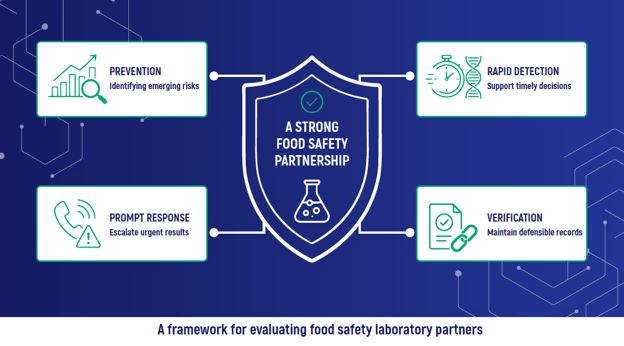
The framework provides a useful starting point, but selecting the right laboratory partner ultimately depends on the questions you ask—and the clarity and substance of the answers you receive. The following considerations can help food safety professionals have a more productive conversation with a prospective laboratory and evaluate existing partnerships.
Prevention: Is Your Laboratory Identifying Risks—or Simply Reporting Results?
Most laboratories can provide pass/fail results. A prevention-focused laboratory helps recognize patterns — gradual shifts in environmental-monitoring results, rising indicator-organism counts, or recurring seasonal variability — so your team can investigate and course correct before there’s a reportable event. A lab that limits its role to routine result reporting or post-failure notification offers a transactional service, not the proactive analytical support needed to strengthen a preventive program.
Trend analysis should also be backed by practical, reliable access to data. A self-service online portal — where teams can review results, compare historical data, and monitor trends on their own schedule — is meaningful evidence that a lab can support proactive decision-making, not just respond when asked.
That doesn’t mean human support is unnecessary — account-manager guidance can be valuable, particularly when providing scientific support for unusual results. But if trend analysis depends entirely on an account manager providing data on a case-by-case basis, the process leaves too much to chance. A strong testing partner combines knowledgeable human support with accessible reporting tools that enable customers to identify and act on emerging risks independently.
Rapid Detection: What Does “Fast” Actually Mean in Practice?
Turnaround time is often one of the first measures laboratories promote. However, it’s important to understand what that number represents in practice.
Some advertised turnaround times reflect only the analytical portion of the test. To be meaningful, turnaround should account for the full process after a sample arrives at the laboratory: receipt and accessioning, sample preparation, enrichment, testing, result review, any required confirmation, and reporting. Where applicable, the laboratory should distinguish between the availability of an initial screening result and the timing of a final reportable result.
Also ask how laboratory cutoff times, weekends, holidays, and incoming sample volume may affect the timeline. If the laboratory offers an online client portal, clarify when results and supporting data will be available there—not simply when the test is complete or a report is issued. Timely access to results is essential when teams must make product-hold, release, investigation, or corrective-action decisions.
It also helps to select a laboratory that offers multiple validated testing options and can direct you toward the method that best fits your specific project requirements. The right approach depends on the organism of concern, product matrix, testing objective, required turnaround time, and any regulatory, customer, or investigative requirements.
For example, molecular methods, such as PCR, can provide rapid presumptive results—often in hours rather than days—which can be critical when a manufacturer needs to place product on hold, make release decisions, or begin an investigation. Traditional culture methods generally require more time but remain important for confirming viable organisms, recovering isolates, and supporting certain regulatory, legal, or investigative needs. In many programs, the two methods work together: rapid molecular testing supports timely screening and decision-making, while culture provides the confirmatory evidence needed in appropriate circumstances.
A capable laboratory partner should be transparent about how its stated turnaround times apply to your specific organisms, product matrices, sample volumes, and operating schedule. The goal is not simply to find the lowest advertised number; it is to establish a testing workflow that provides timely, scientifically appropriate information for the decisions your team must make.
Prompt Response: Who Will Contact You When a Result Requires Immediate Action?
Turnaround time only matters if you hear about the result in time to act on it. A laboratory’s responsiveness is most apparent when an unexpected result requires a timely decision, so before selecting a testing partner, clarify exactly how the laboratory will communicate a presumptive positive or other urgent finding—particularly outside normal business hours.
Ask who is responsible for contacting your team, whether that person is a named primary or backup contact, and how quickly notification occurs after the result is reviewed. It is also important to understand whether the laboratory will proactively call or email designated contacts, or whether your team is expected to discover the result by checking a client portal or waiting for a routine report.
Same-day sample initiation can be an important indicator of laboratory responsiveness, especially for time-sensitive food-safety testing. However, the speed of the analytical process is only part of the equation. A rapid presumptive result has limited operational value if communication is delayed until the next business day.
For perishable products and fast-moving production environments, even a few hours can affect whether product remains under a controlled hold, can be released, or has already entered distribution. A strong laboratory partner should have a defined, dependable escalation process that supports prompt notification, clear next steps, and informed decisions when time matters most.
Verification: What Evidence Will You Have When It Matters?
When an unexpected result occurs, supporting documentation can be as critical as the result itself. Before selecting a laboratory partner, understand how the laboratory confirms findings and what records it can provide if your organization must respond to a regulator, support a customer communication, investigate a supplier-related concern, or defend a product-hold or release decision.
A reliable laboratory should have a clear, consistent confirmation workflow, particularly for presumptive positive pathogen results or other findings that may require additional investigation. The laboratory should also be able to provide documentation that supports traceability and informed decision-making—not merely a standalone result report.
Depending on the testing program and situation, that documentation may include the reported result, method information, sample identification and chain-of-custody details, applicable confirmation records, and any other information needed to demonstrate how the result was generated and reviewed. The objective is to ensure your team has a complete, defensible record that can withstand scrutiny from an auditor, regulator, customer, or legal reviewer without requiring last-minute efforts to reconstruct the facts.
Your Laboratory Partner: An Unseen Extension of Your Brand
Your laboratory is, in many respects, an unseen extension of your brand, and safeguarding that reputation begins well before a recall or other quality event. The four considerations outlined above—prevention, rapid detection, prompt response, and verification—provide a practical framework for evaluating whether a laboratory can do more than process samples. A strong partner should help your organization identify emerging risks, obtain timely and scientifically appropriate results, communicate clearly when action is required, and maintain documentation that supports confident decisions.
Whether you are selecting a new laboratory partner or reassessing an existing relationship, these questions can help determine whether your testing program is equipped to support food safety, operational continuity, regulatory readiness, and long-term brand protection.
This post builds on themes from the recent webinar, Beyond Results: How Lab Partnerships Strengthen Food Safety and Brand Protection, featuring Pace® food safety expert, Ingrid Gumbs-Diaz B.S. M.B.A. To learn more about food-safety testing capabilities from Pace®, visit the food safety testing page.